225+ Goddess Names: Beautiful, Powerful, Unique Names and Meanings
From Athena and Artemis in Greek mythology to Lakshmi and Saraswati in Hindu traditions, goddess names connect language with stories about wisdom, love, nature, protection, and transformation.
This guide brings together 225 name entries across 15 categories. It explores mythological figures, their traditional associations, and creative naming ideas that can help you find a name suited to your needs.
A note about meanings: A goddess’s traditional role is not necessarily the literal meaning of her name. Some names belong to living religious traditions and should be approached with appropriate cultural respect.
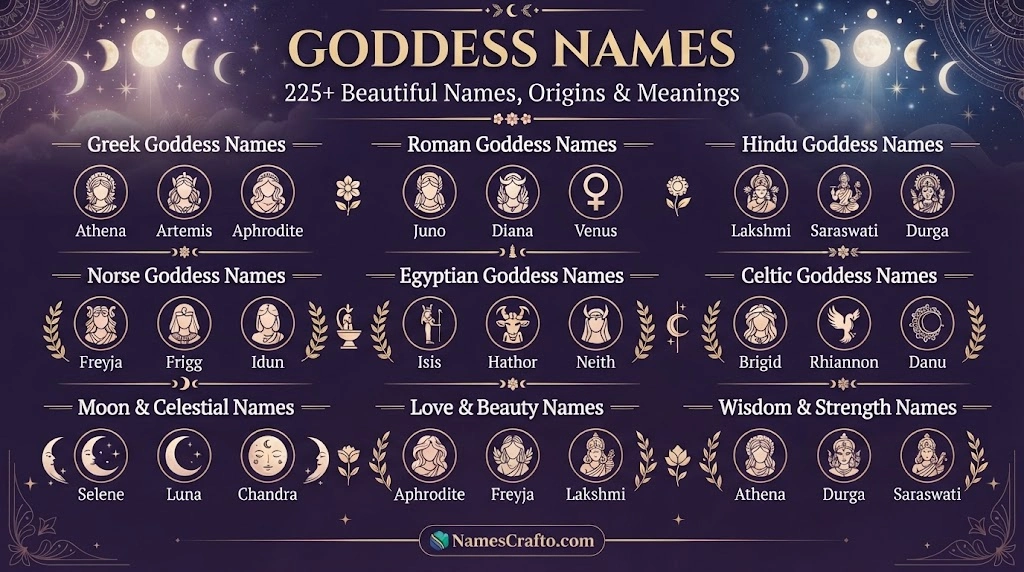
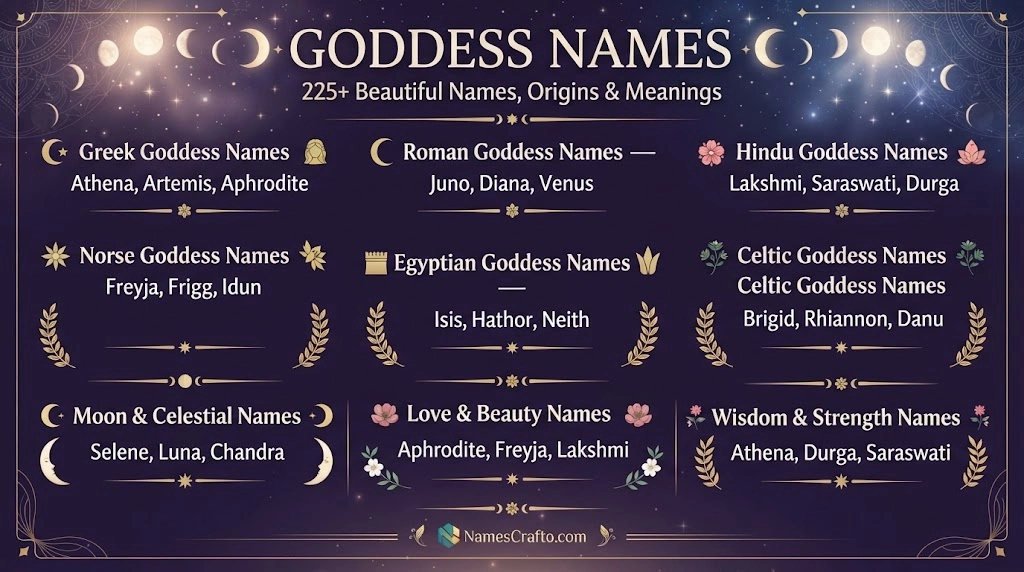
Greek Goddess Names
Greek mythology offers names associated with wisdom, love, nature, the heavens, and the mysteries of existence.
| Name | Traditional association | Naming style |
| Athena | Wisdom, strategy, and crafts | Intelligent and confident |
| Aphrodite | Love and beauty | Romantic and expressive |
| Artemis | Hunting and wilderness | Independent and adventurous |
| Hera | Marriage and queenship | Regal and classic |
| Gaia | Earth | Natural and simple |
| Demeter | Agriculture and grain | Traditional and grounded |
| Persephone | Underworld and seasonal mythology | Dramatic and elegant |
| Selene | The Moon | Soft and celestial |
| Nyx | Night | Short and mysterious |
| Hestia | Hearth and household fire | Warm and understated |
| Iris | Rainbow and divine messages | Bright and approachable |
| Rhea | Titaness and divine motherhood | Classic and concise |
| Eos | Dawn | Short and luminous |
| Asteria | Stars and nocturnal divination | Rare and celestial |
| Thalassa | Sea | Distinctive and oceanic |
Best for: Readers interested in classical mythology, recognizable personal names, or characters whose stories involve wisdom, nature, mystery, or the heavens.
Roman Goddess Names
Roman religious traditions offer names associated with marriage, wisdom, peace, agriculture, fortune, and the natural world. Some became familiar personal names long after antiquity.
| Name | Traditional association | Naming style |
| Juno | Marriage and queenship | Regal |
| Minerva | Wisdom and crafts | Intellectual |
| Venus | Love and beauty | Romantic |
| Diana | Hunting and wilderness | Timeless |
| Ceres | Agriculture and grain | Historical |
| Vesta | Hearth and household fire | Quiet and classic |
| Fortuna | Fortune and chance | Distinctive |
| Flora | Flowers and flowering plants | Nature-inspired |
| Aurora | Dawn | Elegant |
| Bellona | War | Bold |
| Luna | The Moon | Short and celestial |
| Proserpina | Underworld and seasonal mythology | Dramatic |
| Pax | Peace | Minimalist |
| Victoria | Victory | Strong and established |
| Concordia | Harmony and agreement | Formal and distinctive |
Best for: People who appreciate Latin-derived names, classical literature, and historical symbolism.
Hindu Goddess Names
Hindu religious traditions include many forms of the divine feminine.
| Name | Traditional association | Naming style |
| Lakshmi | Prosperity and auspiciousness | Graceful and established |
| Saraswati | Knowledge, learning, music, and speech | Scholarly |
| Durga | Protection and the defeat of evil | Strong |
| Parvati | Devotion, motherhood, and divine power | Traditional |
| Kali | Time, transformation, and fierce divine power | Intense |
| Gauri | A name associated with Parvati | Classic |
| Uma | A name associated with Parvati | Short and simple |
| Aditi | Boundlessness and a Vedic mother goddess | Elegant |
| Gayatri | Sacred Vedic meter and a goddess in Hindu traditions | Traditional |
| Radha | Divine love and devotion | Romantic |
| Sita | A central figure in the Ramayana | Timeless |
| Ganga | The sacred river personified as a goddess | Nature-connected |
| Yamuna | The sacred river personified as a goddess | Distinctive |
| Annapurna | Nourishment and food | Meaningful and traditional |
| Lalita | Divine beauty and playfulness in certain traditions | Soft and lyrical |
Best for: Readers researching Hindu religious traditions or exploring names connected with South Asian heritage.
Naming insight: Lakshmi, Saraswati, Uma, Aditi, Radha, and Sita have established naming histories.
Norse Goddess Names
Norse mythology includes goddesses and other female divine figures associated with love, magic, marriage, healing, nature, and the world of the dead.
| Name | Traditional association | Naming style |
| Freyja | Love, fertility, war, and magic | Bold and lyrical |
| Frigg | Marriage, motherhood, and prophecy | Classic |
| Idun | Apples and renewal | Fresh and unusual |
| Sif | Family and associations with fertility and grain | Short |
| Skadi | Mountains, winter, and hunting | Strong |
| Hel | Ruler of a realm of the dead | Dark and dramatic |
| Eir | Healing in Norse sources | Minimalist |
| Gefjon | Fertility and the plough in surviving traditions | Uncommon |
| Nanna | A figure associated with Baldr | Soft |
| Sigyn | A figure associated with Loki | Distinctive |
| Ran | Sea and those lost to it | Short and mysterious |
| Jord | Earth personified | Natural |
| Gullveig | A figure in the Völuspá narrative | Mythic and unusual |
| Syn | A goddess or divine figure associated with refusal or defense in later descriptions | Brief and distinctive |
| Fulla | A goddess associated with Frigg and her confidences | Rare and historical |
Best for: Mythology enthusiasts, fantasy writers, and readers interested in names with Scandinavian or Old Norse connections.
Naming insight: Freyja and Idun have distinctive mythological identities.
Egyptian Goddess Names
Ancient Egyptian religion developed across many centuries, and divine figures could have different associations in different places and periods. These names reflect important elements of Egyptian religious history.
| Name | Traditional association | Naming style |
| Isis | Magic, healing, and protection | Recognizable |
| Hathor | Music, joy, love, and motherhood | Warm |
| Bastet | Protection, cats, and domestic life | Distinctive |
| Sekhmet | Power, warfare, and healing | Fierce |
| Neith | Weaving, hunting, and warfare in different traditions | Historical |
| Nut | The sky | Short |
| Ma’at | Truth, justice, and cosmic order | Philosophical |
| Taweret | Pregnancy and childbirth | Historical |
| Nephthys | Funerary protection and mourning | Dramatic |
| Wadjet | Royal protection | Unusual |
| Nekhbet | Royal protection and the vulture | Historical |
| Tefnut | Moisture and aspects of the natural world | Distinctive |
| Seshat | Writing, record-keeping, and measurement | Scholarly |
| Mut | Motherhood and divine queenship | Short |
| Serqet | Scorpions and protection against their venom | Powerful |
Best for: Readers exploring ancient Egyptian history, mythology, and characters inspired by ancient civilizations.
Naming insight: Isis, Hathor, and Bastet are widely recognizable in mythology discussions.
Celtic Goddess Names
| Name | Tradition and association | Naming style |
| Brigid | Irish; poetry, healing, and smithcraft | Strong and established |
| Morrigan | Irish; war, fate, and sovereignty | Dramatic |
| Danu | Associated with the Tuatha Dé Danann; details are debated | Ancient and mysterious |
| Áine | Irish; sovereignty, summer, and prosperity in later tradition | Lyrical |
| Epona | Gaulish; horses and protection | Distinctive |
| Rhiannon | Welsh; a prominent figure in the Mabinogi | Elegant |
| Cerridwen | Welsh; inspiration and transformation | Magical |
| Arianrhod | Welsh; a figure in the Fourth Branch of the Mabinogi | Unusual |
| Modron | Welsh; a maternal figure linked to earlier traditions | Historical |
| Macha | Irish; sovereignty, conflict, and horses in different stories | Bold |
| Clíodhna | Irish; a figure associated with otherworldly traditions | Romantic |
| Ériu | Irish; sovereignty and the land of Ireland | Concise |
| Flidais | Irish; associated with wild animals and forests in surviving stories | Nature-inspired |
| Tailtiu | Irish; associated with land and harvest traditions | Rare |
| Airmed | Irish; associated with healing in Irish mythology | Distinctive |
Best for: Readers exploring Irish and Welsh mythology, Celtic history, or characters inspired by medieval literature.
Slavic and Baltic Goddess Names
Slavic and Baltic traditions contain divine and mythological figures associated with fertility, seasonal change, fate, the earth, and the natural world.
| Name | Tradition or association | Naming style |
| Mokosh | Slavic; fertility, women, and domestic work in historical interpretations | Earthy |
| Morana | Slavic; winter and death in several traditions | Dark and dramatic |
| Zorya | Slavic; dawn and celestial guardianship in later mythological accounts | Celestial |
| Lada | Associated with Slavic folklore, though aspects of the goddess tradition are debated | Simple |
| Živa | Slavic; life and fertility in some traditions | Bright |
| Vesna | Slavic; spring in folklore and later interpretations | Fresh |
| Devana | Slavic; hunting and wilderness in later accounts | Adventurous |
| Mokosh-related forms | Modern adaptations of a Slavic divine name | Cultural and creative |
| Laima | Baltic; fate and fortune in Latvian tradition | Elegant |
| Saule | Baltic; the Sun | Bright |
| Māra | Latvian; a major female divine figure with varied associations | Traditional |
| Žemyna | Lithuanian; Earth and fertility | Nature-inspired |
| Gabija | Lithuanian; sacred fire and the household | Warm |
| Austėja | Lithuanian; bees and fertility in later descriptions | Distinctive |
| Medeina | Lithuanian; forests and wilderness in historical accounts | Natural |
Best for: Readers interested in Eastern European and Baltic mythological traditions.
- Explore More: https://namescrafto.com/spanish-middle-names/
Mesopotamian and Ancient Near Eastern Goddess Names
Ancient Mesopotamian and neighboring Near Eastern traditions include female deities associated with love, warfare, the heavens, creation, and the natural world. Their names preserve some of the oldest written religious histories.
| Name | Historical tradition and association | Naming style |
| Inanna | Sumerian; love, power, and warfare | Bold |
| Ishtar | Mesopotamian; love, sexuality, and warfare | Dramatic |
| Ereshkigal | Mesopotamian; underworld | Mysterious |
| Ninhursag | Sumerian; mother goddess and creation traditions | Ancient |
| Nanshe | Sumerian; justice, divination, and social responsibility in surviving texts | Scholarly |
| Nisaba | Sumerian; writing, grain, and scribal learning | Intellectual |
| Gula | Mesopotamian; healing | Short and historical |
| Nintu | Mesopotamian; birth and creation in certain traditions | Traditional |
| Nammu | Sumerian; primordial waters and creation | Distinctive |
| Tiamat | Babylonian creation epic; primordial saltwater | Dramatic |
| Aya | Mesopotamian; a goddess associated with dawn and the sun god Shamash | Short |
| Nanaya | Mesopotamian; love and related divine associations | Lyrical |
| Shala | Mesopotamian; associated with grain and weather traditions | Simple |
| Antu | Mesopotamian; a goddess associated with Anu | Ancient |
| Damkina | Mesopotamian; associated with Enki and motherhood | Historical |
Best for: Writers, students, and mythology enthusiasts exploring ancient civilizations and early written literature.
Japanese and Chinese Mythological Names
Japanese Shinto traditions and Chinese mythology include divine figures connected with the Sun, Moon, compassion, agriculture, and the natural world. Their names and identities should be understood within their own cultural settings.
| Name | Tradition and association | Naming style |
| Amaterasu | Japanese Shinto; Sun and heavenly authority | Regal |
| Ame-no-Uzume | Japanese mythology; dance and joyful revelation | Expressive |
| Konohanasakuya-hime | Japanese mythology; blossoms and Mount Fuji traditions | Elaborate |
| Toyotama-hime | Japanese mythology; a sea-related princess in the Kojiki and Nihon Shoki traditions | Mythic |
| Benzaiten | Japanese religious traditions; arts, eloquence, and music | Artistic |
| Inari | Japanese Shinto; kami associated with rice and prosperity, not exclusively female | Cultural |
| Izanami | Japanese creation mythology | Ancient |
| Kichijōten | Japanese Buddhist tradition; prosperity and beauty | Formal |
| Chang’e | Chinese mythology; Moon | Celestial |
| Xiwangmu | Chinese mythology; Queen Mother of the West | Regal |
| Mazu | Chinese folk religion; maritime protection | Protective |
| Nüwa | Chinese mythology; creation and restoration | Creative |
| Doumu | Chinese religious traditions; a celestial mother figure | Cosmic |
| He Xiangu | One of the Eight Immortals in Chinese traditions; female immortal rather than a goddess in every account | Distinctive |
| Houtu | Chinese religious traditions; Earth and land | Earthy |
Best for: Readers exploring East Asian mythology, literature, religion, or culturally grounded fictional characters.
African Goddess Names and Divine Figures
African religious traditions are diverse, encompassing many peoples, languages, and spiritual systems.
| Name | Tradition and association | Naming style |
| Oshun | Yoruba; fresh water, love, and beauty | Lyrical |
| Yemaya | Yoruba and related diaspora traditions; motherhood and the sea | Oceanic |
| Oya | Yoruba; winds, storms, and transformation | Powerful |
| Oba | Yoruba; a river-associated orisha in relevant traditions | Short |
| Yewa | Yoruba; a divine figure with associations varying by tradition | Distinctive |
| Ala | Igbo; earth and morality in Igbo religious traditions | Concise |
| Idemili | Igbo; a sacred water-associated figure in some traditions | Historical |
| Aje | Yoruba; wealth and economic prosperity in relevant religious contexts | Minimalist |
| Mawu | Fon and related West African traditions; a creator deity, understood differently across traditions | Cosmic |
| Nana Buluku | Fon and related traditions; primordial creator figure | Ancient |
| Asase Yaa | Akan; Earth and fertility | Earthy |
| Nyame | Akan; supreme creator deity, not exclusively a goddess | Cosmic |
| Mbaba Mwana Waresa | Zulu; rain, agriculture, and fertility | Distinctive |
| Woyengi | Ijaw; creator figure in Ijaw traditions | Mythic |
| Neith | Ancient Egyptian; associated with weaving, hunting, and warfare in different traditions | Historical |
Best for: Readers researching African spiritual traditions, literature, and culturally grounded creative projects.
Naming insight: Yoruba orisha traditions and Igbo, Akan, Fon, and Zulu traditions are not interchangeable.
Indigenous American and Pacific Island Goddess Names
Indigenous American and Pacific Island traditions contain diverse narratives about creation, land, water, ancestry, and the natural world.
| Name | Tradition and association | Naming style |
| Coatlicue | Aztec; earth and generative power | Powerful |
| Coyolxauhqui | Aztec; moon-associated figure in Mexica mythology | Celestial |
| Chalchiuhtlicue | Aztec; water and rivers | Nature-inspired |
| Chicomecóatl | Aztec; maize and nourishment | Agricultural |
| Xochiquetzal | Aztec; beauty, flowers, and crafts | Floral |
| Ix Chel | Maya; associated with the Moon, childbirth, and weaving in historical interpretations | Distinctive |
| Ixmucane | Maya; an ancestral creator figure in the Popol Vuh | Ancient |
| Pachamama | Andean traditions; Earth and nourishment | Earthy |
| Mama Quilla | Inca traditions; Moon | Celestial |
| Pele | Native Hawaiian tradition; volcanoes and volcanic power | Dramatic |
| Haumea | Hawaiian tradition; a major ancestral and generative figure | Distinctive |
| Poliʻahu | Hawaiian tradition; snow and mountain associations | Cool and elegant |
| Papahānaumoku | Hawaiian tradition; Earth mother in the Kumulipo and related traditions | Ceremonial |
| Sedna | Inuit traditions; marine animals and the sea in different narratives | Oceanic |
| Atira | Pawnee tradition; Earth-associated divine figure | Historical |
Best for: Readers studying Indigenous traditions, cultural history, and mythology-inspired writing.
Naming insight: These names should not be presented as generic fantasy decorations.
Goddess Names Associated With the Moon, Stars, and Night
Celestial names appeal to readers who prefer imagery associated with the night sky, lunar cycles, or the heavens. This category combines established divine names with figures whose traditional roles are connected with celestial imagery.
| Name | Tradition | Association |
| Luna | Roman | The Moon |
| Selene | Greek | The Moon |
| Nyx | Greek | Night |
| Eos | Greek | Dawn |
| Asteria | Greek | Stars and nocturnal divination |
| Astraea | Greek | Justice and the stars in later mythological tradition |
| Elatha | Irish mythology | A figure associated with the Fomorians; not a moon goddess |
| Hina | Polynesian traditions | Female figure with lunar associations in some island traditions |
| Chang’e | Chinese mythology | The Moon |
| Coyolxauhqui | Aztec | Moon-associated figure |
| Mama Quilla | Inca traditions | The Moon |
| Amaterasu | Japanese Shinto | The Sun |
| Wadjet | Egyptian | Royal protection and cobra imagery |
| Nut | Egyptian | The sky |
| Zorya | Slavic traditions | Celestial guardianship in later mythological accounts |
Best for: Readers drawn to celestial symbolism, fantasy settings, and names that evoke night, stars, or light.
Naming insight: Not every figure in a celestial collection is a moon goddess.
Goddess Names Associated With Love, Beauty, and Grace
Names associated with love and beauty can suit readers exploring romantic mythology, fictional characters, or names with an elegant sound. The associations below describe traditional roles, not personality traits guaranteed by a name.
| Name | Tradition | Association |
| Aphrodite | Greek | Love and beauty |
| Venus | Roman | Love and beauty |
| Freyja | Norse | Love and other divine domains |
| Hathor | Egyptian | Love, music, joy, and motherhood |
| Lakshmi | Hindu | Prosperity, beauty, and auspiciousness |
| Radha | Hindu | Divine love and devotion |
| Oshun | Yoruba | Fresh water, love, and beauty |
| Xochiquetzal | Aztec | Beauty, flowers, and crafts |
| Parvati | Hindu | Devotion, motherhood, and divine power |
| Anahita | Ancient Iranian traditions | Water and other divine associations |
| Astarte | Ancient Near Eastern traditions | Love, fertility, and warfare in different contexts |
| Nanaya | Mesopotamian | Love and related divine associations |
| Sridevi | Hindu traditions | An epithet associated with Lakshmi |
| Kamakhya | Hindu traditions | Desire and fertility in the relevant religious context |
| Aine | Irish traditions | Sovereignty, summer, and prosperity in later accounts |
Best for: Readers looking for romantic, graceful, or historically meaningful names.
Naming insight: Venus and Aphrodite have closely related roles in classical mythology, while Lakshmi, Radha, and Oshun belong to different living or historically continuous traditions. Their meanings should not be flattened into a single universal concept of beauty.
Goddess Names Associated With Wisdom, Courage, and Protection
Some readers prefer names connected with knowledge, courage, leadership, or protection. This group focuses on figures whose stories include one or more of those themes.
| Name | Tradition | Association |
| Athena | Greek | Wisdom and strategic warfare |
| Minerva | Roman | Wisdom, crafts, and strategy |
| Saraswati | Hindu | Knowledge, learning, and music |
| Durga | Hindu | Protection and the defeat of evil |
| Sekhmet | Egyptian | Power, warfare, and healing |
| Neith | Egyptian | Weaving, hunting, and warfare |
| Brigid | Irish | Poetry, healing, and smithcraft |
| Morrigan | Irish | War, fate, and sovereignty |
| Bellona | Roman | War |
| Seshat | Egyptian | Writing and measurement |
| Eir | Norse | Healing |
| Macha | Irish | Sovereignty, conflict, and horses in different stories |
| Oya | Yoruba | Winds, storms, and transformation |
| Amaterasu | Japanese Shinto | Sun and heavenly authority |
| Nüwa | Chinese mythology | Creation and restoration |
Best for: Readers who want a name with a meaningful association for a story, character, or personal naming decision.
Naming insight: Courage and wisdom are broad themes, not literal translations of these names. If you are choosing a name for a real person, also consider the name’s pronunciation, family context, and cultural significance.
Unique Goddess-Inspired Names for Characters and Creative Identities
Not every creative project needs the exact historical name of a goddess. Sometimes a writer or game designer wants a fresh name inspired by celestial imagery, mythology, or a particular atmosphere.
The following are original creative naming suggestions, not historical goddess names. Their value lies in their sound and fictional use, not in claims about ancient origins or established meanings.
| Creative name | Suggested fictional vibe | Potential use |
| Auralune | Moonlit and elegant | Fantasy protagonist |
| Nyxara | Mysterious and nocturnal | Game character |
| Veloria | Regal and graceful | Fictional queen |
| Solmira | Bright and celestial | Fantasy heroine |
| Lunavelle | Soft and lunar | Character or creative profile |
| Thaloria | Oceanic and grand | Sea-magic character |
| Astraelle | Star-inspired and lyrical | Fantasy persona |
| Veylora | Enigmatic and refined | Fictional deity |
| Emberlynx | Fiery and agile | Gaming identity |
| Moonveil | Mysterious and atmospheric | Username or fictional order |
| Starwhisper | Gentle and magical | Fantasy character |
| VelvetOracle | Dramatic and enigmatic | Role-playing identity |
| MythicMaven | Clever and mythology-inspired | Social profile |
| NovaMuse | Creative and celestial | Art account |
| RuneBloom | Magical and nature-inspired | Fantasy or gaming persona |
Best for: Fiction writers, role-playing enthusiasts, gamers, and creators who want a distinctive name inspired by mythology without claiming it is an authentic historical name.
Naming insight: Before using a creative name publicly, check its availability on the intended platform and review existing trademarks where commercial use is planned. A name’s uniqueness cannot be guaranteed without checking relevant databases and platforms.
How to Choose the Right Goddess Name
The best choice depends on what the name needs to accomplish. A name that works beautifully for a fictional character may not be the right fit for a baby, business, or public-facing username.
Start by answering five questions:
- What is the name for? A baby, a character, a username, a pet, or a creative project?
- What matters most? Meaning, sound, cultural origin, pronunciation, or uniqueness?
- How will it be used? In everyday conversation, in a fantasy setting, or on a public social profile?
- Does it have cultural or religious significance? Learn the history before using a name from a living tradition.
- Can you verify the details? Check spelling, origin, pronunciation, and existing use.
Which names work for different purposes?
| Purpose | Useful starting points | What to check |
| Baby name | Iris, Diana, Uma, Aditi | Family preferences, pronunciation, cultural context |
| Fictional character | Persephone, Asteria, Ereshkigal | Character role and historical accuracy |
| Gaming identity | Nyx, Skadi, Moonveil | Availability, readability, platform rules |
| Fantasy worldbuilding | Thalassa, Arianrhod, Veylora | Cultural inspiration and originality |
| Social media profile | NovaMuse, RuneBloom, MythicMaven | Username availability and brand consistency |
| Academic project | Athena, Isis, Inanna | Historical sources and accurate terminology |
These are starting points, not universal recommendations. The right choice depends on the intended audience and context.
People Also Ask
A: Athena, Aphrodite, Artemis, Freyja, Isis, Lakshmi, Saraswati, Durga, Venus, and Gaia are recognizable names associated with major mythological or religious traditions. Familiarity varies by country and culture.
A: Athena and Minerva are associated with wisdom and strategy, Saraswati with knowledge and learning, and Seshat with writing and measurement. Their roles come from different religious and historical traditions.
A: Aphrodite and Venus are associated with love and beauty, while Freyja, Hathor, Lakshmi, and Oshun have related associations in their respective traditions. Their stories and religious significance differ.
A: Selene and Luna personify the Moon in Greek and Roman traditions. Chang’e is associated with the Moon in Chinese mythology, and Mama Quilla is associated with the Moon in Inca traditions.
A: A name may feel unique because it is unfamiliar in a particular language, has an unusual spelling, or comes from a less commonly explored mythology. Actual rarity depends on the country, language, and current naming patterns.
Conclusion
Goddess Names bring together mythology, language, history, and creative identity. Some are familiar and easy to pronounce; others offer unusual sounds and stories that reward further research.
Start with the purpose of your name, identify the qualities or cultural connections that matter to you, and verify the information before making a final choice.
If you are researching mythology, explore the original stories. If you are choosing a personal name, consider how it will be used in everyday life. When you are creating a character or username, decide whether a historically grounded name or an original invention better serves your project.
A meaningful name is more than a label. It is a connection to a story, an identity, or an idea. Save this guide for inspiration, and explore the relevant cultural references before settling on your final choice.







1 thought on “Goddess Names: 225+ Beautiful Names & Meanings”