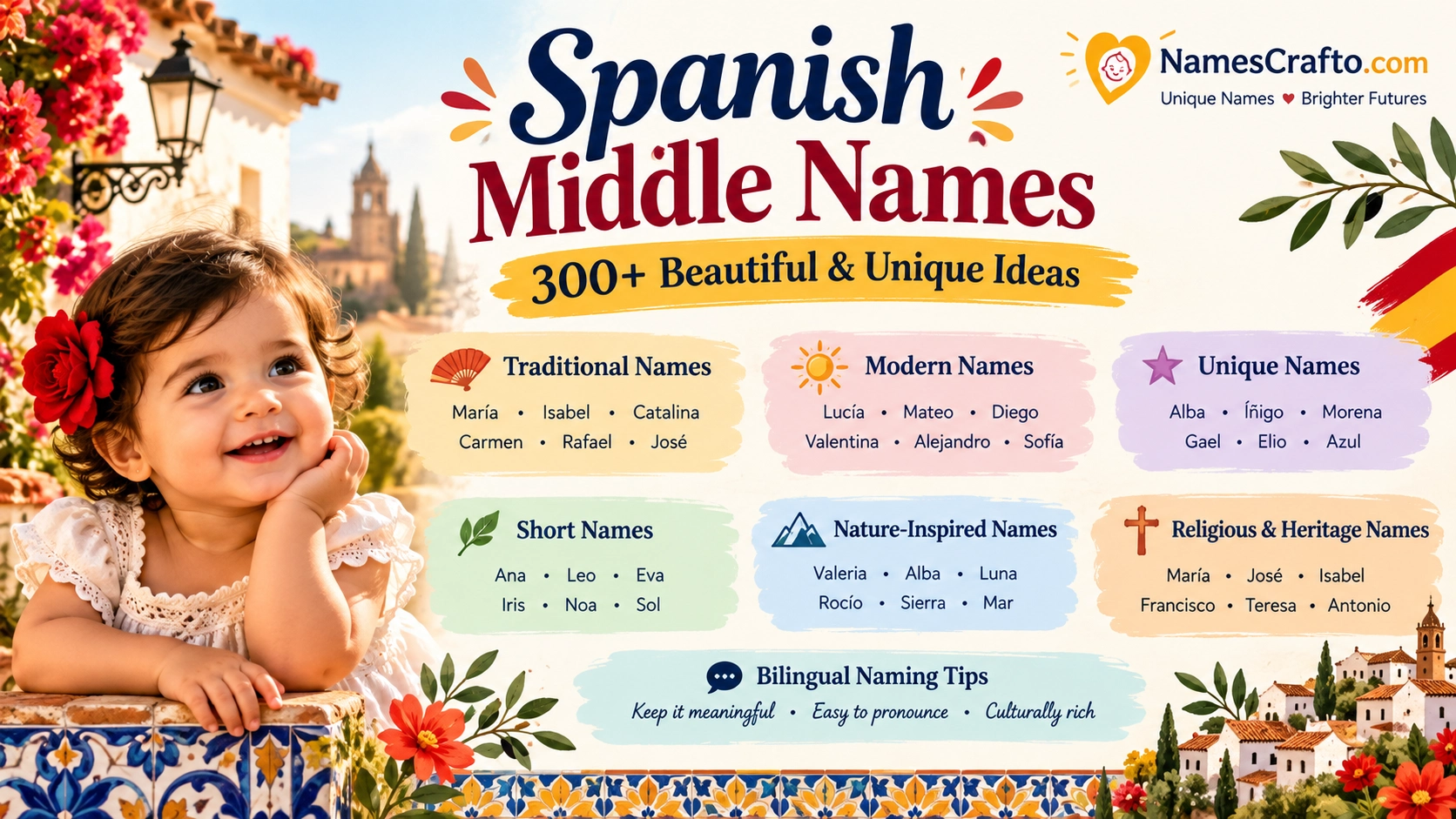
Spanish Middle Names: 300+ Beautiful, Traditional & Unique Ideas
Choosing a middle name is about more than finding something that sounds pretty. A great Spanish Middle Name can connect a child to family heritage, language, faith, history, or simply a beautiful naming tradition.
This guide brings together 225 carefully selected Spanish and Spanish-used names, organized by style and purpose. You’ll find traditional favorites, modern choices, rare ideas, short names, meaningful names, compound names, bilingual combinations, and practical tips for choosing a name that works with the complete name.
One important distinction comes first: the English concept of a “middle name” does not perfectly match traditional Spanish naming. Spanish naming commonly involves one or two given names followed by surnames, and compound given names are also established in Spanish usage.
Best Spanish Middle Names for Any Style
The best middle name depends on the first name, surname, family background, and style you want. These versatile choices cover classic, contemporary, elegant, and distinctive tastes.
15 versatile ideas:
- Lucía — bright and graceful
- Mateo — classic and contemporary
- Isabel — timeless and elegant
- Gabriel — traditional and strong
- Valentina — romantic and sophisticated
- Rafael — classic with religious heritage
- Carmen — unmistakably established in Spanish usage
- Santiago — distinctive and traditional
- Elena — polished and internationally familiar
- Javier — classic Spanish choice
- Catalina — refined and historic
- Nicolás — traditional with a modern feel
- Paloma — distinctive and nature-linked
- Sebastián — formal and melodic
- Beatriz — elegant and established
For current Spain-specific context, the INE’s latest published newborn data lists Sofía as the most frequent girl name and Mateo as the most frequent boy name among babies born in 2024. That makes them useful reference points when discussing contemporary naming in Spain, although popularity does not automatically mean they are the best middle names for every family.
Spanish Middle Names for Girls
Spanish girl names range from traditional Marian names to contemporary choices. The names below are selected for their Spanish usage, sound, heritage, or strong compatibility as middle names.
15 girl ideas:
- Adriana
- Alejandra
- Amalia
- Antonia
- Ariadna
- Aurora
- Belén
- Cecilia
- Claudia
- Daniela
- Estela
- Gabriela
- Jimena
- Mariana
- Verónica
These names can suit families looking for something feminine without being limited to the most obvious choices such as María or Carmen.
Spanish Middle Names for Boys
Spanish boy names offer plenty of choices ranging from compact middle names to longer, formal options.
15 boy ideas:
- Adrián
- Alonso
- Álvaro
- Andrés
- Antonio
- Arturo
- Carlos
- Diego
- Eduardo
- Emilio
- Fernando
- Ignacio
- Joaquín
- Rodrigo
- Vicente
Accent marks matter for names such as Álvaro, Adrián, Andrés, and Joaquín when using their standard Spanish spellings.
Traditional Spanish Middle Names
Traditional names are especially useful when the goal is to honor grandparents, preserve family heritage, or create a name with a strong historical connection.
Spanish naming traditions have long included saint names and names associated with Marian devotion. Names such as Dolores, Rosario, Mercedes, Pilar, and Luz are documented examples of this tradition.
15 traditional ideas:
- María
- José
- Juan
- Francisco
- Manuel
- Miguel
- Pedro
- Teresa
- Dolores
- Mercedes
- Rosario
- Pilar
- Concepción
- Esperanza
- Soledad
These choices can work particularly well when the middle name has a family or religious significance.
Modern Spanish Middle Names
“Modern” should not automatically mean “new.” Many contemporary favorites are established names that remain popular with newer generations.
15 modern-style ideas:
- Aitana
- Alba
- Alma
- Abril
- Vega
- Valeria
- Martina
- Noa
- Olivia
- Gael
- Hugo
- Iker
- Luca
- Thiago
- Enzo
Popularity varies by country and year, so use “modern” as a style description rather than assuming that every name is currently among the most popular in every Spanish-speaking community.
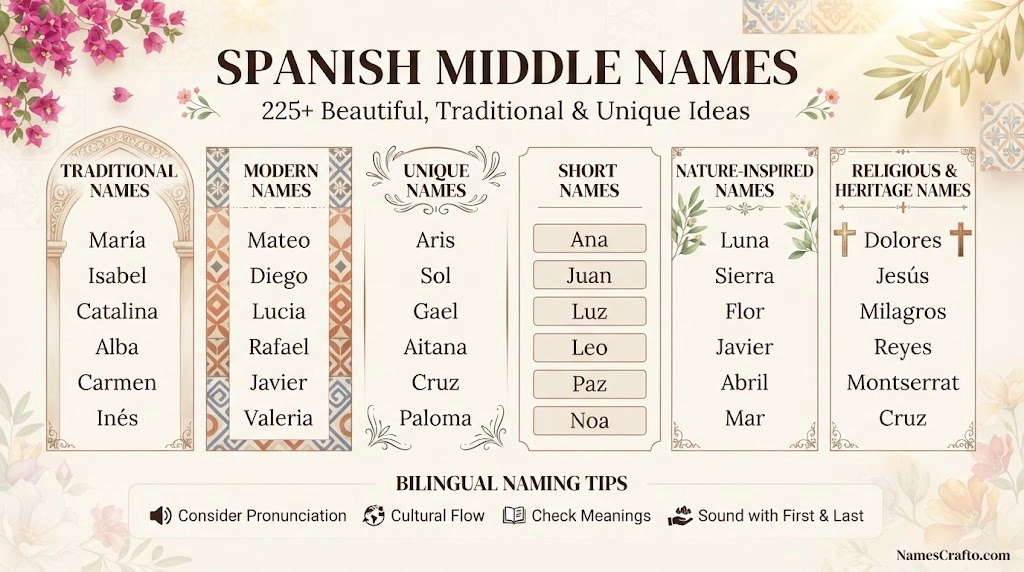
Unique Spanish Middle Names
If your child’s first name is common, a less familiar middle name can add individuality. Unusual, however, should not mean difficult to pronounce or culturally disconnected.
15 distinctive ideas:
- Araceli
- Azahara
- Mencía
- Nieves
- Aránzazu
- Macarena
- Amparo
- Milagros
- Fabiola
- Cayetana
- Íñigo
- Gonzalo
- Ramiro
- Baltasar
- Cayetano
Some of these names have particularly strong regional, historical, or religious associations. For example, the etymology of Mencía is uncertain, so it is better to describe it as historically Spanish/Medieval Spanish rather than assigning it an overly confident single meaning.
Cute Spanish Middle Names
A cute middle name can have a light, warm sound while still functioning as a formal given name.
15 cute ideas:
- Lola
- Lía
- Nina
- Alma
- Cora
- Vera
- Estela
- Perla
- Sol
- Two
- Nico
- Dani
- Leo
- Milo
- Rafa
A useful naming rule is to distinguish formal names from nicknames. For example, Lola can be used independently but is also associated historically with Dolores, while Nico can function as a familiar short form of Nicolás.
If the name will appear on legal documents, decide whether you want the full formal name or the nickname itself.
Short Spanish Middle Names
Short middle names can create excellent rhythm when the first or surname is long.
15 short ideas:
- Ana
- Eva
- Luz
- Paz
- Sol
- Mar
- Inés
- Alba
- Rosa
- Noa
- Cruz
- Juan
- Luis
- José
- León
Try saying the complete name aloud rather than judging the middle name alone.
For example:
Alexander José Rivera
has a different rhythm from:
Alexander Sebastián Rivera
Neither structure is universally better; the important question is which one flows naturally with the family’s surname.
Spanish Middle Names With Beautiful Meanings
Meaning can turn a middle name into a personal message. However, name etymology is sometimes complicated, so meanings should be treated as established interpretations rather than guaranteed one-word translations.
15 meaningful ideas:
- Alba — dawn
- Aurora — dawn
- Paz — peace
- Paloma — dove
- Estrella — star
- Luz — light
- Esperanza — hope
- Clara — bright or clear
- Victoria — victory
- Rosa — rose
- Perla — pearl
- Celeste — heavenly or celestial
- Félix — fortunate or happy
- Salvador — savior
- Valentina — associated with strength and health
For example, Paloma is documented as a Spanish name meaning “dove,” while Mercedes has a religious history connected with the Spanish title Nuestra Señora de las Mercedes.
Spanish Compound Middle Names
Compound names deserve their own category because Spanish naming traditions include established combinations of two given names.
Examples documented in Spanish name references include José Luis, José Antonio, José Manuel, José María, Francisco Javier, and María Carmen.
15 compound-name ideas:
- María José
- María Isabel
- María Teresa
- María Elena
- María Luisa
- María Belén
- María Pilar
- María Rosario
- María Mercedes
- Ana Belén
- Juan Pablo
- Juan Manuel
- José Miguel
- José Antonio
- Francisco Javier
Compound names can be particularly meaningful when they honor two relatives or combine two family traditions.
They can also work differently depending on whether your family is following Spanish naming conventions or adapting a Spanish name into an English-language three-name structure.
- Explore More: https://namescrafto.com/celtic-names/
Spanish Middle Names for Bilingual Families
For bilingual families, the best middle name is often one that sounds natural in both languages.
15 bilingual-friendly ideas:
- Elena
- Clara
- Sofia
- Lucia
- Isabel
- Diana
- Julia
- Marina
- Camila
- Emilia
- Daniel
- Gabriel
- Adrian
- Rafael
- Marco
If you want the Spanish spelling, remember that names such as Sofía, Lucía, and Adrián normally include accent marks in Spanish.
The INE’s current Spanish statistics show that names can be analyzed by national, regional, and other demographic dimensions, which reinforces an important point: “popular in Spain” and “popular across all Spanish-speaking families” are not interchangeable claims.
Spanish Nature-Inspired Middle Names
Nature-inspired names can bring a softer, more visual quality to a full name.
15 nature-inspired ideas:
- Luna — moon
- Sol — sun
- Mar — sea
- Flor — flower
- Rosa — rose
- Perla — pearl
- Estrella — star
- Aurora — dawn
- Alba — dawn
- Coral — coral
- Marina — sea-related
- Celeste — celestial
- Vega — associated with a meadow or fertile plain
- León — lion
- Río — river
Not every name in this category originated exclusively in Spanish. The purpose here is to identify names that work naturally within a Spanish-language or Spanish-inspired naming context.
Spanish Religious & Heritage Middle Names
Religious heritage has played an important role in Spanish naming, particularly through saints and Marian devotional titles. Names such as Carmen, Dolores, Mercedes, Pilar, Rosario, and Luz are examples documented in Spanish naming references.
15 heritage-focused ideas:
- Guadalupe
- Asunción
- Piedad
- Consuelo
- Trinidad
- Carmen
- Dolores
- Mercedes
- Pilar
- Rosario
- María
- José
- Jesús
- Ángel
- Santiago
This category can be especially meaningful for families choosing a name connected to Catholic heritage, a patron saint, a Marian title, or a family tradition.
At the same time, religious association varies between countries and families, so the name should be evaluated within the specific heritage you are honoring.
Spanish Middle Names by Regional & Cultural Style
“Spanish” is not one single naming culture. Spain and Spanish-speaking Latin America share a language and many historical naming traditions, but individual countries and communities have their own preferences.
15 regionally interesting ideas:
- Xabier
- Aitor
- Unai
- Yeray
- Iker
- Ximena
- Guadalupe
- Marisol
- Belén
- Rocío
- Paloma
- Macarena
- Araceli
- Mencía
- Cayetana
Some names have particularly strong regional associations. Xabier, Aitor, and Unai, for example, should not simply be presented as interchangeable “generic Spanish names.” A culturally careful article should identify regional or linguistic associations where relevant.
Likewise, Guadalupe has important usage in Mexican and broader Latin American contexts; Spanish name references specifically identify María Guadalupe as a Mexican Spanish combination.
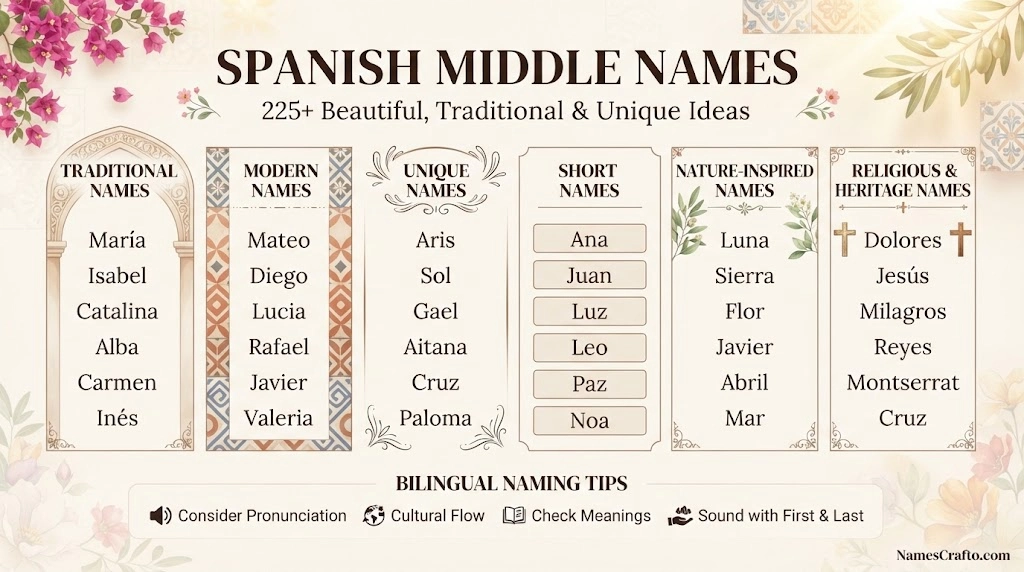
Elegant Spanish Middle Names
If your goal is an elegant, polished full name, look for a middle name with clear pronunciation, strong rhythm, and a style that will age well.
15 elegant ideas:
- Catalina
- Beatriz
- Leonor
- Constanza
- Valentina
- Victoria
- Gabriela
- Adriana
- Cecilia
- Emilia
- Alejandro
- Sebastián
- Fernando
- Rafael
- Rodrigo
A good elegant middle name does not have to be extremely rare. In fact, an established name often gives a full name more natural rhythm and longevity.
How to Choose the Right Spanish Middle Name
The fastest way to narrow hundreds of options is to stop asking only “Which name is prettiest?” and start asking “Which name fits our complete naming goal?”
1. Decide What You Want the Name to Represent
Choose your main reason:
- Family heritage
- Spanish language
- Religious tradition
- Grandparent honor
- Meaning
- Sound
- Regional identity
- Bilingual compatibility
- Uniqueness
A clear purpose makes the shortlist much easier.
2. Check the Full Name
Always test:
First + Middle + Surname
Say it naturally several times.
Listen for:
- repeated sounds
- awkward consonant combinations
- excessive syllables
- initials
- rhythm
- pronunciation differences
3. Check the Accent
Names such as José, Sofía, Lucía, Nicolás, Andrés, Álvaro, and Íñigo should not have their accent marks casually removed if you intend to use the standard Spanish spelling.
4. Think About Formality
Ask whether you want the name to sound:
- traditional
- youthful
- elegant
- religious
- modern
- rare
- international
A middle name can be more traditional than the first name and still create an attractive combination.
5. Research the Specific Cultural Context
If your family is from Spain, investigate Spanish usage in Spain.
If your family heritage is Mexican, Colombian, Argentine, Cuban, Puerto Rican, Chilean, Peruvian, or from another Spanish-speaking community, research that particular tradition too.
This avoids treating every Spanish-speaking community as culturally identical.
6. Don’t Confuse a Nickname With a Formal Name
A nickname can be perfect for everyday use without necessarily being the formal name you want on a birth certificate.
For example:
Nicolás → Nico
Dolores → Lola
Francisco → Paco
The choice depends on whether you want the full traditional form, the familiar form, or both.
Spanish Middle Names: Quick Style Comparison
| Style | What to prioritize | Example types |
| Traditional | Heritage and longevity | María, José, Juan |
| Modern | Contemporary sound | Alba, Aitana, Mateo |
| Elegant | Rhythm and sophistication | Catalina, Beatriz, Sebastián |
| Short | Simple pronunciation | Luz, Paz, Leo |
| Rare | Distinctiveness | Mencía, Íñigo |
| Religious | Faith and heritage | Pilar, Rosario, Santiago |
| Nature | Visual meaning | Luna, Paloma, Estrella |
| Bilingual | Easy cross-language pronunciation | Elena, Clara, Gabriel |
How Spanish Naming Traditions Differ From the English “Middle Name”
This is one of the most important pieces of information for anyone researching Spanish middle names.
A typical traditional Spanish naming pattern can involve one or two given names followed by surnames, rather than the English first-middle-last structure.
Spanish legal naming rules have also changed over time. The Spanish Civil Registry framework regulates given names and surnames separately, and Spanish law has provisions concerning the order in which surnames are transmitted.
Therefore, a family using a Spanish name in an English-speaking country may be making a cultural adaptation rather than reproducing the traditional Spanish legal naming structure exactly.
That distinction is worth explaining because it prevents a common mistake: assuming that “Spanish middle name” has one universal definition.
How to Make a Spanish Middle Name Sound Natural
Use the sound test.
Say the name:
- Slowly.
- At normal speaking speed.
- With the surname.
- As if introducing the child.
- As if calling the child from another room.
- As if the person were an adult.
- In both languages if your family is bilingual.
Also check the initials.
For example, a beautiful first-middle combination may create an unfortunate set of initials with the surname.
Spanish Accent Marks: Why They Matter
Accent marks are not merely decorative. They can affect pronunciation and spelling.
Examples include:
- Álvaro
- Andrés
- Adrián
- José
- Joaquín
- Nicolás
- Sebastián
- Lucía
- Sofía
- Inés
- Rocío
- Íñigo
If your child has a Spanish name, preserving the correct spelling is part of preserving the name itself.
For a publication-ready naming resource, avoid stripping accents simply to make names look more familiar to English-speaking readers.
Current Spanish Naming Trends: What the Data Actually Says
Rather than labeling every fashionable-looking name as “trending,” use official statistics where available.
Spain’s National Statistics Institute currently reports Sofía as the most frequent name for newborn girls and Mateo as the most frequent name for newborn boys for 2024.
For residents as of January 1, 2025, the INE reports María Carmen as the most frequent female name and Antonio as the most frequent male name in Spain. It also lists María, Manuel, José, Carmen, and other long-established names among the country’s most frequent resident names.
This illustrates why “popular” needs a time frame. A name can be highly prevalent among the overall population because of older generations while a different name is currently more common among newborns.
People Also Ask
A:Spanish naming does not exactly follow the English first-middle-last model. Traditionally, a person may have one or two given names followed by surnames.
A:Popular choices include traditional names such as María, José, Juan, Carmen, and Isabel, while current Spanish newborn data places Sofía and Mateo at the top for girls and boys respectively in 2024.
A:Lucía, Valentina, Isabel, Catalina, Elena, Paloma, and Beatriz are strong options, depending on whether you prefer modern, traditional, elegant, or distinctive styles.
A:Mateo, Gabriel, Rafael, Javier, Santiago, Nicolás, Sebastián, and Diego are versatile choices.
A:No. Spanish can refer specifically to Spain, the Spanish language, or broader Spanish-language usage depending on context. Hispanic generally refers to Spanish-speaking cultural or linguistic connections. Individual countries have their own naming preferences.
Conclusion
Choosing the right Spanish Middle Name is about more than finding a name that sounds beautiful. The best choice should fit your child’s first name and surname while reflecting your family’s heritage, personal values, cultural connection, or preferred style.
Whether you prefer a traditional name like María or José, an elegant choice such as Isabel or Catalina, a modern option like Alba or Mateo, or a distinctive name such as Mencía or Íñigo, there are plenty of meaningful possibilities to explore.
Before making your final choice, say the complete name aloud, check its pronunciation and accent marks, consider its cultural or regional associations, and make sure it works naturally with the surname. If you are choosing a name for a bilingual family, test how it sounds in both languages.
Ultimately, the perfect Spanish middle name is the one that feels meaningful to your family and sounds natural as part of the complete name. Take your time, shortlist your favorites, and choose a name that your child can carry proudly from childhood into adulthood.










1 thought on “Spanish Middle Names: 300+ Beautiful & Unique Ideas”